

UUIDv7 functions
Create a hypertable partitioned by time-based UUIDv7
UUIDv7 is a time-ordered UUID that includes a Unix timestamp with millisecond precision in its first 48 bits. Like other UUIDs it uses 6 bits for version and variant info. The remaining 74 bits are random.
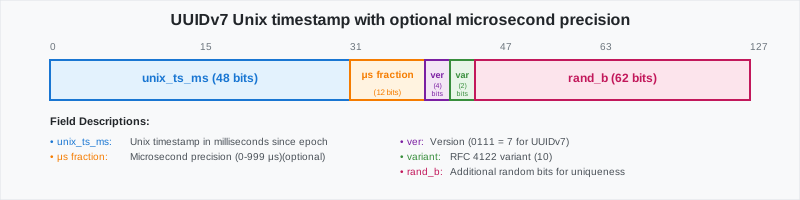
UUIDv7 is ideal anywhere you create lots of records over time. Advantages are:
- No extra column required to partition by time with sortability: you can sort UUIDv7 instances by their value. This is useful for ordering records by creation time without the need for a separate timestamp column.
- Indexing performance: UUIDv7s increase with time, so new rows are appended near the end of a B-tree. This results in fewer page splits, less fragmentation, faster inserts, and efficient time-range scans.
- Easy keyset pagination:
WHERE id > :cursorand natural sharding. - UUID: safe across services, replicas, and unique across distributed systems.
UUIDv7 also increases query speed by reducing the number of chunks scanned during queries. For example, in a database with 25 million rows, the following query runs in 25 seconds:
WITH ref AS (SELECT now() AS t0)SELECT count(*) AS cnt_ts_filterFROM events e, refWHERE uuid_timestamp(e.event_id) >= ref.t0 - INTERVAL '2 days';Using UUIDv7 means that chunks are excluded at startup, and the query time is reduced to 550 ms:
WITH ref AS (SELECT now() AS t0)SELECT count(*) AS cnt_boundary_filterFROM events e, refWHERE e.event_id >= to_uuidv7_boundary(ref.t0 - INTERVAL '2 days')You use UUIDs for events, orders, messages, uploads, runs, jobs, spans, and more.
Samples
Section titled “Samples”-
High-rate event logs for observability and metrics:
UUIDv7 gives you globally unique IDs for traceability and time windows such as “last hour”, without the need for a separate
created_atcolumn. UUIDv7 creates less churn because inserts land at the end of the index, and you can filter by time using UUIDv7 objects.- Last hour:
SELECT count(*) FROM logs WHERE id >= to_uuidv7_boundary(now() - interval '1 hour');
- Keyset pagination:
SELECT * FROM logs WHERE id > to_uuidv7_boundary($last_seen::timestamptz) ORDER BY id LIMIT 1000;
- Last hour:
-
Workflow / durable execution runs:
Each run needs a stable ID for joins and retries. UUIDs help by serving both as the primary key and a time cursor. For example:
SELECT run_id, statusFROM runsWHERE run_id >= to_uuidv7_boundary(now() - interval '5 minutes') -
Orders / activity feeds / messages (SaaS apps):
Human-readable timestamps are not mandatory in a table. However, you still need time-ordered pages and day/week ranges. UUIDv7 enables clean date windows and cursor pagination with just the ID. For example:
SELECT * FROM ordersWHERE id >= to_uuidv7_boundary('2025-08-01'::timestamptz)AND id < to_uuidv7_boundary('2025-08-02'::timestamptz)ORDER BY id;
Available functions
Section titled “Available functions”generate_uuidv7(): generate a version 7 UUID based on the current timeto_uuidv7(): create a version 7 UUID from a PostgreSQL timestampto_uuidv7_boundary(): create a version 7 “boundary” UUID from a PostgreSQL timestampuuid_timestamp(): extract a PostgreSQL timestamp from a version 7 UUIDuuid_timestamp_micros(): extract a PostgreSQL timestamp with microsecond precision from a version 7 UUIDuuid_version(): extract the version of a UUID